
Collaborating, fast and slow
Observations and reflections from week five as Head of Innovation at SYMCA...

I’m a bit funny about the terms ‘collaboration’ and ‘collaborative’. Most organisations have them somewhere in their core values. Maybe the terms are losing a bit of meaning, or they’re flattening our capability to really embrace / enact what they’re meant to embody.
That said, collaboration as a concept has been front and centre for us this week. How do we do it together as a team? How do with do with others, both inside SYMCA and outside with citizens and external organisations?
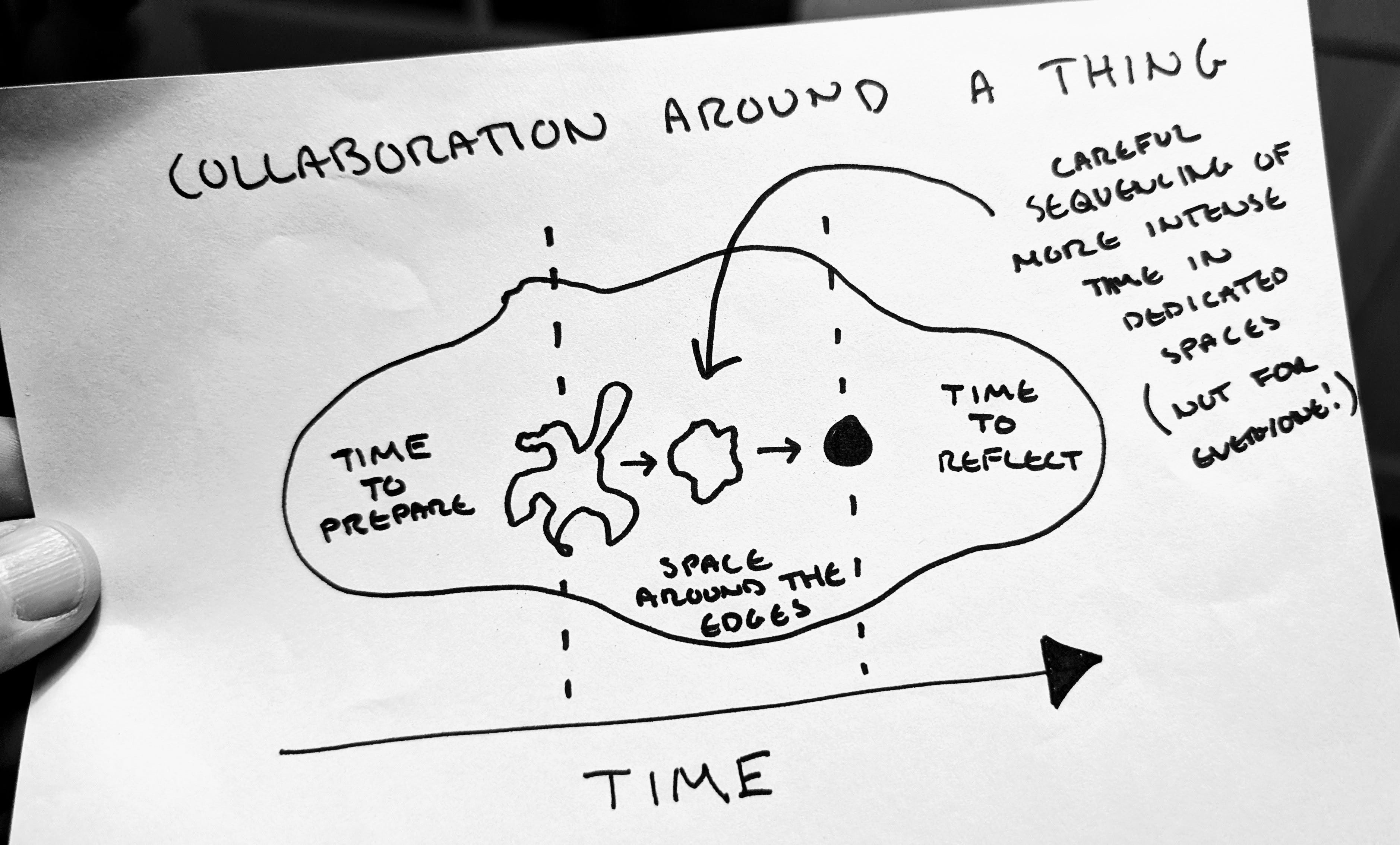
Collaboration is not just getting together in a room, either a real one or a virtual one. It requires consideration, planning, intentional sequencing/structuring and multiple touch points to make it proper. It’s such a key part of our work - broad participation, user research, design, meaningful evaluation - that we need to give it some thought and design our own version of it. Moreover, different ways of collaborating work for different people, so how might we develop our version so that it caters for the variety of people’s needs, preferences and personalities?
So, borrowing from Thinking, Fast and Slow, which came up twice this week in different conversations, we’re thinking about how we apply a similar lens to our methods of collaborating.
Other things happened or were explored this week too…
Priority questions this week
As we start to feel more established as individuals and as a team, how do we align and harmonise the team’s working practices whilst feeling confident of our individual roles within that?
How might we ‘bank’ and prioritise the emergent opportunities we’re already seeing for us to start supporting and doing things more tangibly?
Rollover from last week: How do we chisel away at the framing of the innovation team’s two challenge to crystallise our focus?
How might we navigate the sludge constructively?
What happened this week?
Went to Barnsley Media Centre for a great event about ‘Practical AI: data foundations for children’s service’, coordinated by RAEng and Barnsley Metropolitan Borough Council.
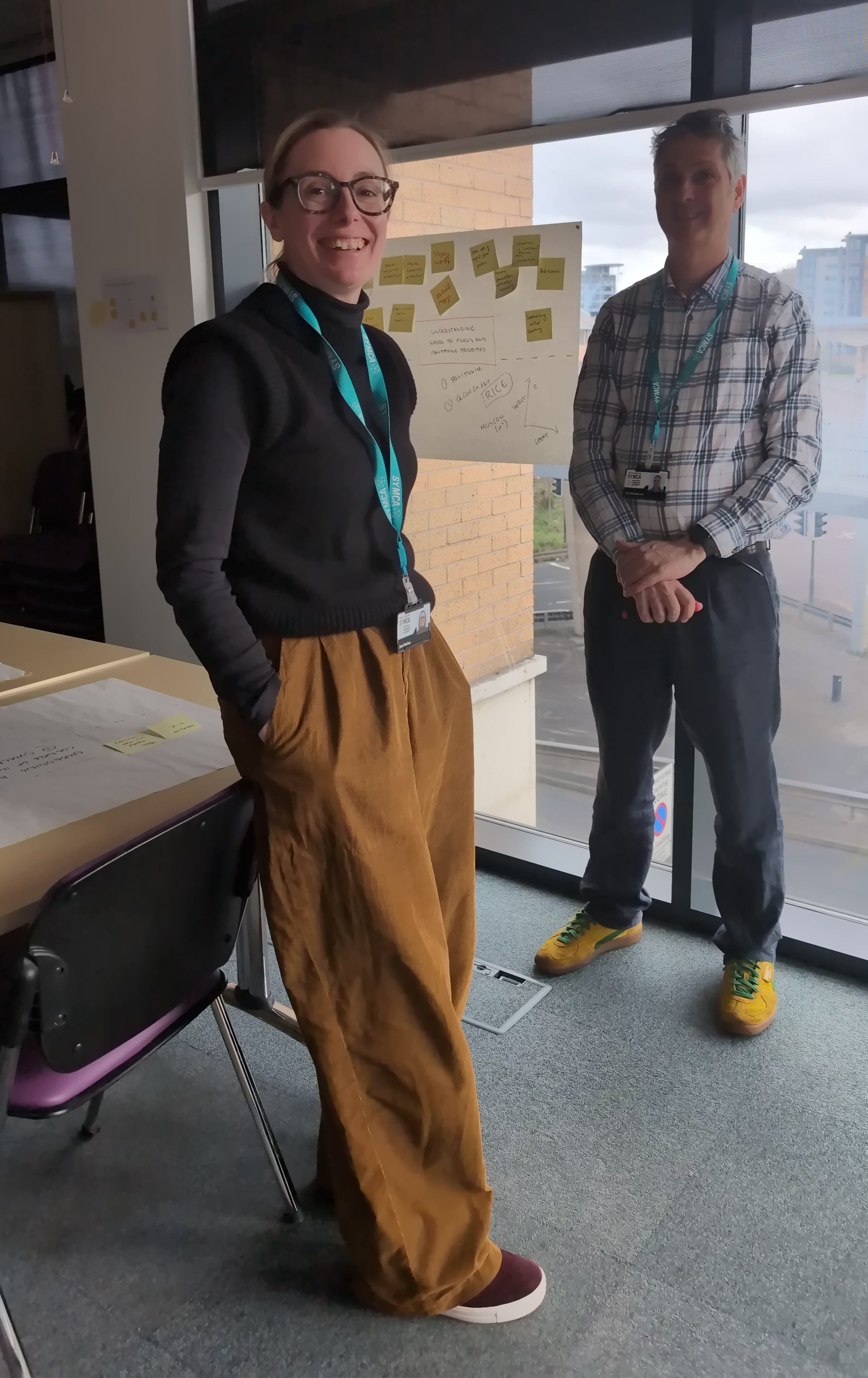
Getting a tighter handle on our key challenge areas of early years literacy and transport, thanks to the hard work and ideas of Jane Mackey and Tim Woolliscroft from the innovation team.
Dedicated time designing our function, roles and responsibilities as the innovation team, including processes for:
Positioning and engagement - Gathering (multiple forms of) research/evidence that enable us to surface opportunities for innovation and prioritise them;
Discovery, testing and learning - How we take these prioritised opportunities, understand them fully, test prototypes in response and then evaluate them;
Convening and stewarding - Bringing people together to handover’ what we’ve learned and to support them in embedding ‘successful’ approaches.
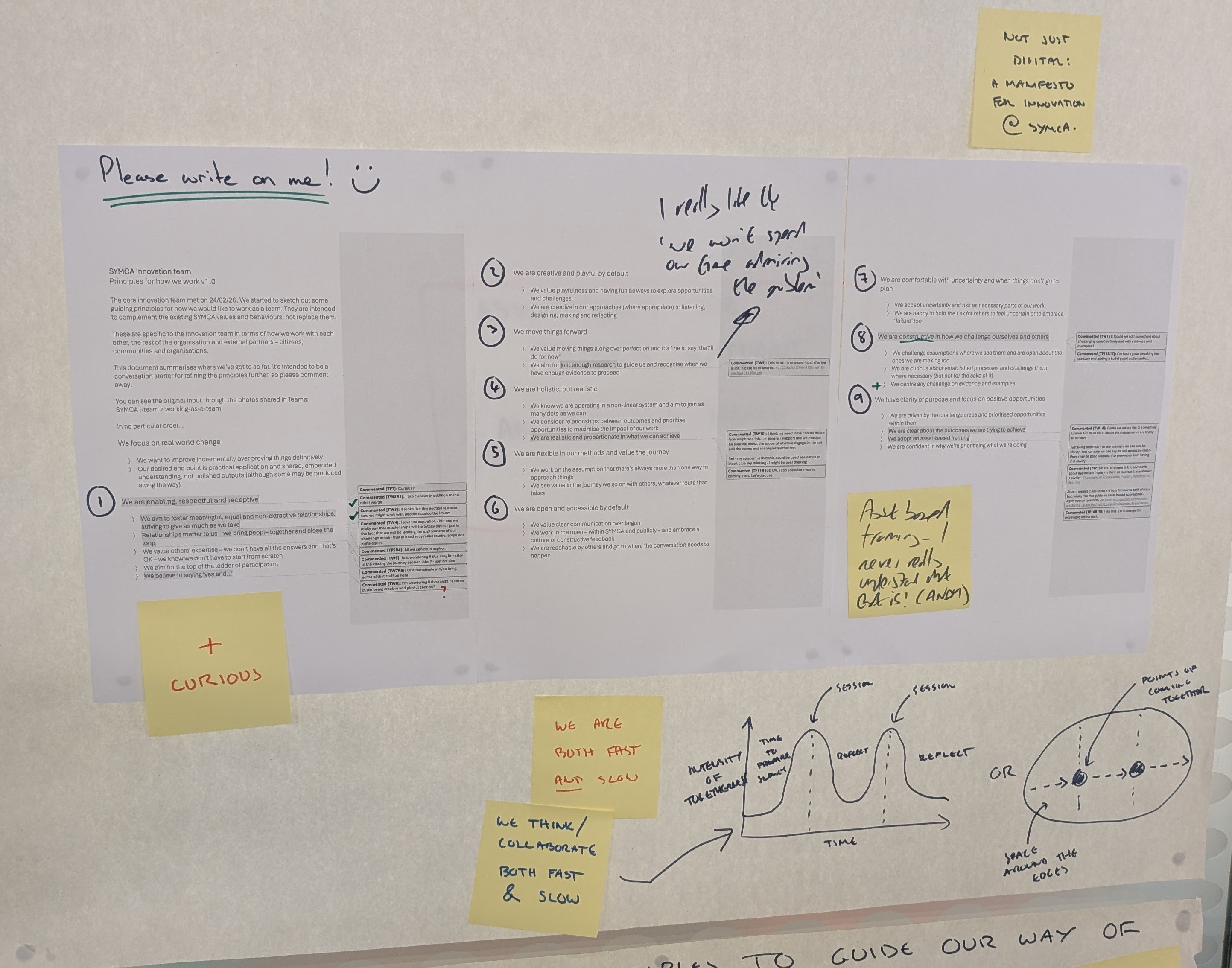
Dedicated time refining our innovation team principles (see below).
I went to the Sheffield Social Enterprise Network (SSEN) conference.
We started to gauge interest in an internal community of practice at SYMCA of people in teams/disciplines related to research, engagement, behavioural insight or evaluation, as well as those innovating already in different parts of the organisation.
More connecting with internal experts and senior leaders at SYMCA, as well as identifying existing innovators or opportunities to innovate around the edges.
Familiarising myself with the emerging South Yorkshire Strategy and SYMCA’s business plan for the year ahead to see where innovation fits in and can support the organisation more broadly.
Personal observations and reflections
It was a good week for the innovation team 🙂 We’ve had really constructive, aligned conversations about the ways we want to work and who does what within that.
That stuff is about what we’ll be doing, but what about the how; our guiding principles for our team’s culture and tone. Well, we’ve ben working on those too! It’s still very much a work on progress (see picture above), but we are certainly in a more refined position than we were this time last week. Incidentally, the process which we’ve gone through to get to this point may be a test case for how we might collaborate fast and slow as a team…
Prepare - create a physical space (a piece of paper on the wall) for individual input over an extended period of time.
Informal get together - individual ad-hoc conversations to maintain momentum around the process.
Structured time - a dedicated whole-team session to:
explore the input so far and add new things;
begin to group things into themes.
Reflection (where we currently are) - themes on the wall for further refinement over an extended period of time.
Reflections from the event in Barnsley:
There are a lot of opportunities for innovation in the early years data space alone - data are held in may different places and there is clear argument for focusing data on early indicators of (expensive) crisis.
Joining up data and enabling multi-agency data sharing feels important and doable. It’s been done well in other places, such as Somerset Council, including how and when consent is obtained in a way that doesn’t introduce layers of extra work.
It’s hard for local authorities to hold the risk for experimenting, both politically and in terms of funding cycles, so how might we innovate in the realm of risk reduction or risk sharing too?
“AI should aid, but not decide.”
The importance of having a shared understanding of what a ‘crisis event’ is and how it’s defined in the data.
Data is a “collection of perspectives” - a service in isolation only collects what’s important to it, but not necessarily to other adjacent services.
Focus on the lowest amount/level of data that gives the highest value (in the broadest sense).
The power of alternative approaches to data collection, governance and participatory decision-making (back to collaboration again!), such as the Civic Data Cooperative in Liverpool, which also reminded me of the recent early stage work in Sheffield to explore a ‘data cooperative’.
Reflections from the SSEN conference:
Lots of interesting stuff related to innovation, particular around how relationships and engagement with partners might look and feel better - more food for thought on the topic of collaboration and the way SYMCA acts as an innovation facilitator.
The keynote speaker, Rob Hopkins:
“Longing on a large scale is what makes history”
“Embark on a journey with purpose...and audacity...not waiting for the perfect solutions”
“We’re not lacking innovation, we’re lacking longing at scale [to embed the innovation]”
Creating a “pop-up tomorrow”
Reflection - How might the innovation team foster a spirit of imagination and create artefacts ‘from the future’?
Panel discussion (paraphrased): “Narrative/comms over commitment is a blocker to change.”
“Dignity by design.”
Excitingly, there’s an appetite for a new community of practice within SYMCA to start sharing examples of what internal innovation already looks like. We’re slowly learning that there are other teams doing similar things to the innovation team with similar values - citizen experience teams, data and insight, evaluation, behavioural insights etc. So, it seems to make sense to join this up loosely and learn from each other. And people seem up for it 🙌
I’ve been reflecting on the tensions I feel between academia and the way I like to work. I think this might also relate a bit to the title of this blog. Multiple ways of learning can happen at any given time, over different timeframes and using different methods. And they can all sit next to each other as equally valid parts of our shared understanding as individuals or organisations. I believe that innovation in the context within which I am now requires a shortening of traditional learning cycles and processes alongside a culture of humility. But it must do this sensitively to accommodate different notions of validity, robustness and consent. It feels like there’s work to do around this.
A bit more general sludge. I’ve been wondering about how certain systems come about and why they’re tolerated. And more Microsoft. Everyone’s busy. But how much of that is onerous process and platforms? Bad or confusing systems take up time, divert focus from the ‘real’ work and sap morale. Accountability, compliance and managing risk are important. But they don’t have to be synonymous with creating arduous infrastructure and experiences. There, I said it.
Where we’d welcome input and ideas
We’re keen to develop our relationships with - and to learn from - our Local Authority colleagues in Barnsley, Doncaster, Rotherham and Sheffield
Tell us about how you’re innovating already and would welcome input in relation to early years literacy or bus franchising, and invite us to get out and about 🙂
We are developing the language around our two ‘challenge’ areas: early years literacy; and bus franchising. Something that’s emerging for us is that the way we frame them - the words we use, the tone etc. - may not resonate with those with whom we wish to learn from, such as citizens or organisations from other sectors. Any thoughts on this would be most welcome.
Thoughts and views on how people would like to partner with, contribute to and benefit from the SYMCA innovation team in the short, medium and long term…
On the radar
People shared a load of stuff with me this week, not all of which I’ve given the time they deserve. Some examples include…
EAST: Four simple ways to apply behavioural insights
Net zero will transform Britain’s economy – our map reveals the most vulnerable places
Love this can’t beat visuals to explain things